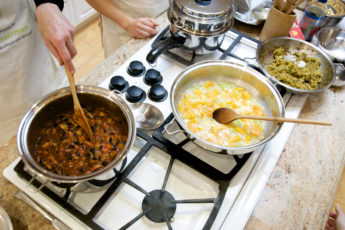
Healthy One-Pot Meals
Join Marni for her One-Pot Meals class on January 28th, see you there!
There’s just something so great about getting cozy with a warm bowl of soup or stew during the cooler days of fall and winter. The best part is how easy it is to make these one-pot meals yourself — in fact, it is easier than preparing your average dinner at home, which usually involves preparing multiple recipes to get a balanced meal.
In order for your one-pot meal to cover all of your nutritional needs, you will need to include a few key ingredients. Make sure your meals have one choice from each of these four categories:
1. Vegetables
Onions, carrots, and celery provide a great base for soup or stew by giving your water some flavour. Next, you can add in seasonal vegetables like squash, sweet potatoes, rutabaga, turnips, parsnips, Brussels sprouts, fennel, broccoli, cauliflower, and kale. You can get really crazy here! Use as many vegetables as you’d like to include.
2. Legumes
These are best when cooked from scratch. Legumes like beans and lentils add a low-fat source of iron, fibre, and protein to your meal. Choose from chickpeas, black beans, white beans, lentils, yellow split peas, kidney beans, mung beans, or black-eyed peas.
3. Herbs and spices
Make sure to have some basics on hand, including cumin, parsley, sage, oregano, garlic, ginger, rosemary, thyme, basil, marjoram, turmeric. Check out my list of six essentials herbs and spices for healthy cooking.
4. Whole grains
Using barley, oats, quinoa, brown rice, or millet can add a dose of complex carbohydrates, texture, and substance to your pot. Whole grains up your dish’s fibre content as well.
There you have it — a well-rounded one-pot meal! These dishes make for a convenient and easy approach to dinnertime in the fall and winter months. You can make a large batch and take portions out as you need them throughout the week, or even warm some up and put it into a stainless steel thermos for you or your kids to take on the go for lunches. You can also freeze portions in glass containers and store them for a snowy day when you don’t feel like cooking or going anywhere.
Why not benefit from cooking some of your own meals at home? You get to be creative, you know what goes into it, it’s convenient, and you know it’s going to be delicious! You can start with this healthy recipe for minestrone soup, featuring seasonal chard and butternut squash, and check out a month’s worth of one-pot recipes here.
New-age minestrone
Ingredients:
1 Spanish onion, cut into large dice
1 tablespoon extra virgin olive oil
1-2 cloves of garlic, minced
1½ teaspoons sea salt
1 tablespoon dried oregano
4-6 cups filtered water or stock
1 bay leaf
1 butternut squash, peeled and cut into medium dice (or roast half squash in oven on 350F for 45 minutes, peel flesh away from skin, and place in pot)
1 sweet potato, cut into large dice
3 ribs celery, cut into large dice
1 large or 2 small zucchini, cut into small chunks
1 bunch of chard, cut into bit-sized pieces
1 cup kidney beans (optional), soaked and cooked
½ cup elbow brown rice noodles (optional), cooked
Procedure:
1. In a small pot, sweat onion in oil with salt until soft.
2. Add oregano and sweat a few more minutes.
3. Add water and bay leaf.
4. Add vegetables in order given (squash, sweet potatoes, celery, zucchini).
5. Turn up heat until water bubbles, then lower and simmer covered for 40-45 minutes.
6. Stir vegetables until squash falls apart.
7. Add in chopped chard.
8. Cover and simmer for 10 minutes.
9. Stir a few more times and serve.
For a smoother texture, simmer the squash separately until soft (in 1-2 cups of water), and puree in a food processor. Add squash to the soup for the last 10 minutes of cooking.
Do you love the simplicity and great taste of this recipe? For more one-pot meal recipes join Marni for her One-Pot Meals class on January 28th, see you there!
This article was originally posted on Chatelaine.com
Make some Millet Madness!
August 29, 2011 by Marni Wasserman
Filed under Delicious Recipes, For Your Health!, Nourishing Resources
Nothing says comfort food like Millet. It is such a special whole grain with such unique characteristics. It doesn’t cook or taste like anything else.
Every now and again I get a huge craving to make a pot of millet. So when I stepped off the plane from my summer trip and felt the cool breeze of fall – I was inspired to turn on my pot and cook up this yellow wholesome grain.
I was feeling like something hearty and colourful for dinner. Since I had so much produce ready to harvest in my garden, I couldn’t help but get my hands on it after 12 days away. I was low on time and didn’t have any beans ready so for a protein boost, so I decided to make a “fully nourished” sauce complete with protein, fiber and chlorophyll.
If you don’t know much about millet here are the specs:
Where: Millet is from Eastern Asia, and was a diet staple in Northern China until 618 A.D. It has remained an important crop not only in Asia but elsewhere in the world. It’s cited in the New Testament, and was a dominant cereal crop into the Middle Ages.
What: Millet is gluten free and high in amino acids (protein!), phosphorus and the B-complex vitamins. It is very easy to digest and alkaline-forming. You can cook it with more water for a millet-mash, or cook it with less water for a fluffy pilaf.
How: Cook millet by first rinsing thoroughly in a fine mesh colander. Then add to pot and heat on low for 1 to 2 minutes (dry toasting) until water is evaporated. Add water (1 1/4 cups water for 1 cup dry millet), bring to a boil and simmer, covered for about 25 minutes (until water is absorbed).
Storage: Millet can be stored in a glass jar in a cool dark cupboard. If purchasing more than a two month supply, store in the fridge or freezer (tightly wrapped).
Use: Make millet into porridge, veggies burgers, toss it into a soup or salad or just a cozy and colourful side dish – that you can add anything into.
Tell Us….
Have you ever made Millet?
What recipes have you made with Millet?
What do you love about Millet?
So get a little mad and make some Millet in your kitchen!
Here is what I put together, in less than an hour!
Garden Fresh Millet Bowl
1 cup millet, rinsed and drained
1/2 butternut squash, cubed and roasted
1 handful swiss chard, chopped into bite size pieces
1 cup green beans, chopped
3 cloves garlic, minced
3 tbsp olive oil
1 tbsp sea salt
1/4 cup chopped fresh parsley
1/4 cup cherry tomatoes, sliced
Preheat oven to 350F.
1. Peel and cube butternut squash in to small pieces, toss with olive oil and sea salt. Place on baking sheet and bake in warm oven for 45 minutes – 1 hour. (Toss and turn after 30 minutes).
2. Rinse millet in a fine mesh colander and drain. Place into pot and dry toast for 1-2 minutes on low heat until water evaporates.
3. Pour in 1 1/2 cups of water, bring to a boil and then lower heat and simmer with the lid closed for 25 minutes (until all the water has absorbed).
4. Wash and chop swiss chard, green beans into small bite size pieces and mince the garlic.
5. In a saucepan over medium heat, add 1 tbsp olive oil + minced garlic. After about 1 minute add in the green beans and stir for another 2 minutes. Add in swiss chard and lightly saute until just soft, but still bright green. Turn off heat.
6. Once squash and millet are done, toss all ingredients into a large bowl and mix together.
7. Garnish with chopped parsley, cherry tomatoes and sea salt to taste.
Green Hemp-Tahini Sauce
2 tbsp tahini (sesame paste)
2 tbsp water
1 scoop Ruth’s Hemp Protein Power with E3 Live + Maca
1 tbsp tamari
1 tbsp lemon juice
pinch of sea salt
Blend all ingredients in a Vita- Mix!! For a smoothie creamy sauce!
Tell Us….
Have you ever made Millet?
What recipes have you made with Millet?
What do you love about Millet?
Good Things Come in Some Packages!
September 9, 2010 by Marni Wasserman
Filed under Cooking Demo's, For Your Health!, Nourishing Resources, Super Foods
On the topic of healthy snacks this week (and just in time for school), it is within my knowledge to show you what is out there. Snacks that you can get your hands on that I approve of. We all need snacks, they are available, but we have a choice to make. If you have a guideline to follow of what to choose, how to choose, then you are taking one step closer to wellness and a healthy body! In a another post you will learn how to make your own snacks at home.
As a general rule, you want to look for whole foods that are packaged. Pure ingredients made from whole grains, nuts, seeds, dried fruits and natural sweeteners. You should be able to read all of the ingredients on the label (and there shouldn’t be more than 5 unless it is jam-packed super bar) and feel confident that you are putting a good product into your body even though it is packaged!
So here is a my approved guideline for healthy packaged snacks (most of which are in my home):
Bars: Lara Bars, Vega Bars, Pro Bar, Honey Bar, Prana Bar, Organic Food Bar (there are more that aren’t listed here, but hopefully you get the idea)
Rice Cakes with Almond Butter
Sun Warrior or Vega Protein Powder with Almond Milk, Hemp Milk or Rice Milk
Pita Break Spelt Crackers with Hummus
Mary’s Crackers with Goat Cheddar
Sheep Yogurt with Granola
Whole Grain Bread with Almond Butter
Go Raw Cookies/Chip/Crackers/Granola
Trail Mixes made from Navitas Naturals Products
Did I miss anything? I am sure I did. What are some of your amazing, wonderful and healthy snacks that you like to buy ?
Please do share, we all want to hear them!
Naturally and Nutritionally Sweet!
November 26, 2008 by Marni Wasserman
Filed under Delicious Recipes, DESSERTS, For Your Health!, Nourishing Resources
Date Almond Pudding
1 tbsp vanilla extract
2 tbsp maple syrup
4 Medjool dates (soaked overnight or boiling water for 20-30 minutes)
2 tbsp of pure unsweetened cocoa powder
1 tbsp almond butter or 1/2 cup raw almonds (soaked in water overnight for 8 hrs.)
1 tsp cinnamonCombine the ingredients in a blender and whirl on high until well blended into a thick creamy pudding.
Divide the pudding into 2 servings
ENJOY!
Whole Grain Goodness
November 10, 2008 by Marni Wasserman
Filed under Delicious Recipes, For Your Health!, Nourishing Resources, SALADS
There are so many to choose from! Different tastes, textures, colours and even shapes. But on a whole, all of them are composed of an amazing source of complex carbohydrates, fiber, b vitamins, trace proteins, minerals and even heart healthy fats that make you feel energized and nourished.What needs to be recognized and understood by many, is that grains can be an essential part of everyone’s daily diet unless candida or carbohydrate metabolism is a problem. But when grains are left intact and prepared properly in their whole form – one requires much less of a portion to be satisfied. These grains are very different from eating a bowl of white pasta, white bread or white rice where you may need a few servings to fill that “hunger” void.
The natural fiber content whole grains also don’t spike your blood sugar levels nearly as much and thus also contribute to feeling satiated for a longer period of time.So the trick is to start simply. Select the grains that are most familiar and then go from there. Most people are accustomed to cooking rice, couscous and maybe even barley. With rice you want to find an organic brown rice. This can be either short grain, long grain or basmati (for simplicity sake). Couscous also exists in wheat counterparts, Spelt and Kamut (these are ancient forms of wheat that are left in their whole form and easier to digest). Also speaking of spelt and kamut, both of which can be cooked in their whole grain form as well…spelt is also known as Farro which comes from Italy. It is a wonderful addition or substitution for a grain in any classic rice dish recipe!
As for barley, there are a few different types – but to start out I would go with a “pearled” form as it is easier to cook. Once you get hooked on grains and they become more familiar, get the whole barley which requires soaking and longer cooking and also has more fiber and nutrients intact.
Then comes the next level of grains which includes many gluten free options for those with digestive disturbances such as celiac disease, ulcerative colitis, crohns and something known as “leaky gut”. These grains (almost seed-like) includes Quinoa, Amaranth, Teff, Millet and Wild Rice to name a few. Recipes for these divine gems can range from loafs, to pilafs, croquettes, soups, salads, cookies and pancakes. Many a cookbook exists on how to venture into the world of grains, including how to soak them, cook them, prepare them using a wide variety of ingredients. “The Splendid Grain” by Rebecca Wood is one in particular that makes cooking and learning about grains really easy and rather fascinating.
My overall advice, is to make sure you have some healthy whole grains on hand, stored properly (in a glass jar) in your cupboards, so that the next time you want a warming and nourishing bowl, side dish or breakfast of delicious goodness they are there and ready to go!
Warm Farro Foutash Salad
Ingredients:
1 cup pearled farro (if the whole form then soak overnight)
1 cup vegetable stock
½ butternut squash, cubed
1 red onion, chopped
1 cup portabello mushrooms, chopped
1 cup rainbow chard, thinly sliced
2 tablespoons olive oil
1 clove garlic, minced
1 tablespoon sea salt
Dash of herb de provence
2 tablespoon balsamic vinegar
¼ cup olive oil
¼ cup toasted walnuts
1/3 cup cranberries or currents
Crumbled goat cheese (optional)
Procedure:
Rinse and place farro into a pot with vegetable stock and 1 cup of water. Bring to a boil, reduce heat and simmer for 1-2 hours.
Set aside farro.
Place cubed butternut squash on a baking tray with 1 tablespoons of olive oil and place in the oven for 30 minutes.
In a saucepan, heat 1 tablespoon olive oil with garlic over medium heat and add mushroom and sauté until softened.
Add spinach, sea salt, dry herbs and balsamic vinegar. Let sit to let the flavours combine for a few minutes.
Place cooked faro into a large bowl, add olive oil, and butternuts squash and onion, mushroom, spinach mixtures and stir everything in.Add pinenuts and crumbled goat cheese