Best Muffins! RT @Glu10FreeGarage: Yes, we have no (more) bananas glutenfreegarage.ca/bananas/ @marniwasserman
Microwave days are over…here are 4 reasons why!
January 9, 2012 by Marni Wasserman
Filed under All, Contests/Giveaways, For Your Health!, Nourishing Resources
You may have thought about it or considered it, or this may come as a complete shock to you, get rid of your microwave! This may sound daunting and even threatening as the reliance on this convenient, easy-to-use appliance has been one of the most purchased and widely used in the last few decades. And guess what, cancer rates have never been higher. I am not saying there is a direct link, but I can say with certainty that there is certainly not positive energy going in your food from the microwave.
Reasons not to use the microwave
1: Electromagnetic Energy
Microwaves are a form of electromagnetic energy, like light waves or radio waves, and occupy a part of the electromagnetic spectrum of power, or energy. Microwaves are very short waves of electromagnetic energy that travel at the speed of light (186,282 miles per second).
As these microwaves are generated from the magnetron, they bombard the food, causing the polar molecules to rotate at the same frequency millions of times a second. All this agitation creates molecular friction, which heats up the food. The friction also causes substantial damage to the surrounding molecules, often tearing them apart or forcefully deforming them.
Radiation causes ionization, which is what occurs when a neutral atom gains or loses electrons. In simpler terms, a microwave oven decays and changes the molecular structure of the food by the process of radiation.
We’ve been told that Microwaving isn’t the same as irradiating. The two processes are supposed to use completely different waves of energy and at different intensities.
2: Toxic Release from Food Packaging
There is a problem with release of potentially toxic molecules into the food from packaging, that are designed to help brown food during microwaving.
Microwaving food inside containers made of plastic, cellophane, cardboard and styrofoam may cause toxins to leach into the food thereby increasing the levels of carcinogens being consumed. Since most containers do not visibly melt or get hot, consumers have the false notion that the synthetic boxes and wrappers are not releasing toxins. They are however, and these toxins can cause hormonal imbalances, lowered sperm count, and various other forms of cancer.
3: EMF’s and Radiation
In the book, Health Effects of Microwave Radiation Microwave Ovens by Dr. Lita Lee, she states that every microwave oven leaks electromagnetic radiation, harms food, and converts substances cooked in it to dangerous toxic and carcinogenic products. There has been contradictory research linked to EMFs (electromagnetic fields) produced by appliances like microwave ovens. Dr. David Carpenter, Dean at the US School of Public Health, State University of New York believes it is likely that up to 30% of all childhood cancers come from exposure to EMFs.
EMFs can be measured with an instrument called a Gauss meter. In fact, here is what one reader has to say when he used a Gauss meter to test microwaves: Measuring with a Gauss meter, every microwave I tested leaked, and was detectable up to six feet away. So just to be on the safe side, it is best to stand back from your microwave when its running.
4: New Compounds formed in your body
Besides the loss of nutrients, microwaving forms new compounds (radiolytic compounds) that are unknown to humans and nature. It is not yet known exactly what these compounds do in the human body. But do you really want the compounds in your food being altered? And then that food entering your body? It doesn’t make for healthy tissues and cells.
There is even a test you can try out at home. Buy two identical plants. Give one regular or filtered water and give the other microwaved water. See what happens over the course of two weeks! If that alone is any indication of what is happening inside your body when consuming microwaved food, I think the answer is loud and clear.
Natural Alternatives:
You may be trying to figure out just how on earth are you going to warm up your food? Well let me give you some insight. Firstly, if you are eating a mostly plant based and vegetarian diet, the good news is that you don’t even have to heat up your food. If it’s already cooked, room temperature is just fine if you are in an office all day long. Just bring your food in reusable containers inside a cooler, and pull it out 1 hour to 30 minutes before you are going to eat.
Especially if you are eating an animal protein based meal, the last thing you want to do is nuke it in the micro. Animals food, being mostly protein, is likely to become so denatured through microwaving, that your body hardly recognizes it. So the same rules below apply for both plant and animal based meals.
- If you have access to a stove: put your food into a pot and warm it for a few minutes on low heat. You can even put your plate or your food in a steamer basket and warm it up that way. Of course this all depends on what the item is.
- If you have access to an oven: transfer your food to a glass dish and warm on a low temperature for 15-20 minutes.
What to do with your microwave:
If it’s portable, take it to a depot that accepts old electronic appliances.
If it’s built in, store things in it. Towels, bowls, plates, pans (just make sure not to turn it on by accident!)
Have more ideas, thoughts or opinions? Share with us!
Resources:
http://www.naturalnews.com/022015.html
http://www.naturalnews.com/034101_microwaveable_containers_plastics.html
http://www.health-science.com/microwave_hazards.html
Delicious Tips for Cancer Awareness and Prevention
November 28, 2011 by Marni Wasserman
Filed under For Your Health!, Nourishing Resources
It’s the end of November and the last two months have been dedicated to Cancer awareness for both women and men. So I am doing my part and sharing with you some of my tips to take your health into your own hands. Whether you have been diagnosed breast or prostate cancer or just working towards preventing, it is important to understand that you are responsible for your own health. You have every power within you to control the things YOU do on a day-to-day basis. You don’t have complete control over such things as genetics, the environments and other extraneous factors (although some would beg to differ), but how you live your life each day up to you!
If your lifestyle choices are positive and health promoting, then you can only help any situation (wherever you are) to make things better. What you eat, what you wear, put on your body and your thoughts all make a difference!
Of all the things that we don’t have the power to manipulate within our lives, you need to focus on what is tangible and realistic.
Take some these preventive steps today to keep your mind and body healthy!
Lifestyle Tips to Prevent, Moderate and Balance!
- Use organic products on your body – shaving cream, makeup, hair. If you can eat it, it can go on your body. Honey and avocado make a great face mask -For Men: Gentleman’s Refinery, Nature Clean Shampoo – For Women: Mad Gabs, Mineral Fusion, Evan Healy, Nature Clean Shampoo
- Sleep soundly on organic hemp or bamboo bedding and mattress
- Choose organic and sustainable clothing made from organic cotton, bamboo or other natural fabrics. Also get yourself some reusable bags to take with you shopping Bazura Bags, RuMe
- Use household cleaners that are non-toxic with natural components such as Nature Clean or be simple and use lemon and vinegar.
- Get plenty of fresh air. Escape up north for a drive and marvel at how amazing life truly is amongst fields, trees and lakes
- When it comes to food, choose local and organic food – avoiding pesticides, chemicals, GMO,
- Use glass storage containers to avoid BPA leaking into your lovingly prepared food check out Wean Green
- Avoid the microwave – why expose yourself to radiation when you have so many alternatives, like the stovetop or the oven.
- Make time for you. Whether it’s through meditation, yoga, exercise, gardening choose to do things that you love on a regular basis.
- Be grateful – we all have daily woes that bring us down, but realistically we are incredibly lucky. Make a list every morning of at least three things you are grateful for. It can be as simple as being able to breath and having hands to hold your loved ones, to having a roof over your head, to having internet access! So many things we take for granted, that if we expressed gratitude every day we would be so much happier and healthier!
- Get yourself a copy of Kris Carr’s Crazy Sexy Life and watch Crazy Sexy Cancer. Amazing tips, ideas, recipes and makes light of the whole C word!
Preventing with Plants
February 15, 2010 by Marni Wasserman
Filed under Delicious Recipes, DESSERTS, For Your Health!, Nourishing Resources
Last week I held a workshop in conjunction with the Holistic cooking Academy. The topic and premise was focused on meal planning for Cancer. Whether you are a cancer survivor or preventing and living each day to it’s full health potential - I discussed the importance and essentials of a plant based diet. There is no better way to attain optimal health than through a plant based diet. Within this very specific yet broad topic there was so much to discuss. But I had to limit myself as this workshop could of gone on for hours. Instead it was a 4 hour class which comprised of a two hour discussion of some of the vital nutrients for cancer and then went on to a hands on cooking class in the kitchen. We made some incredible and tasty recipes!
There are many different dietary approaches when it comes to Cancer and when it comes to any kind of healing for that matter.
Here are some of the possible dietary approaches:
- vegetarian/vegan
- superfoods/raw foods (sprouting, smoothies, etc.)
- macrobiotic diet
- organic whole foods / balanced proteins, carbs, fats
Here are the FOOD GROUPS for Optimal Health:
1. Vegetables
With a strong emphasis on veggies… ideally 50 % of your meals should come from vegetables. Leafy greens are amongst the most important and are often neglected (Kale, spinach, swiss chard, collards, bok choy and the list goes on). Let’s not forget about sea vegetables either – this includes Arame, Dulse, Nori, Kombu and Wakame. They are especially beneficial in preventing breast cancer. Almost all vegetables can be eaten raw or lightly steamed.
2. Fruits
Fruit is best eaten between meals or at least 1/2 hour before other foods. It is also best to eat fruit in season rather than stored, bottled or frozen.
3. Legumes (beans, lentils, split peas…)
Excellent source of protein, carbohydrates, dietary fiber and many important nutrients. Approximately 15% of your meals should come from this category.
4. Whole Grains
This includes the whole grain and preferably gluten free grains such as quinoa, amaranth, millet, brown rice, wild rice and limited amounts of spelt, kamut, barley, oats and rye. Grains should comprise of a good part of a balanced diet as whole grains are high in fiber, complex carbohydrates and B vitamins. Whole grains provide long lasting energy and are critical nerve conduction. Try to limit/avoid refined and processed flours and flour containing products – they are high in sugar and stripped of their essential nutrients.
5. Animal protein
Best avoided, but this is not the case for everyone. So if you feel you must consume meat, limit it to wild-caught fish, naturally raised organic poultry, and small amounts of organic, pasture-fed beef. Dairy is mucus forming, and is best avoided. Good quality kefir, sheep’s milk or organic dairy is an exception, and can be consumed in moderation.
6. Soy
Fermented soy products (tempeh, miso, tamari) and edamame (young soy beans) are beneficial. Tofu and other processed soy products (milk, cheese, ice cream, soy protein) should be avoided. These foods have been considered healthy meat and dairy alternatives for a long time, however recent research shows that they are poorly digested and may even inhibit proper protein digestion.
7. Nuts and seeds
Up to 5% of your meals should come from this category. Nuts and seeds are high in protein and healthy fats, and they supply various vitamins and minerals as well. Soaking and dehydrating will make nuts more easily digestible. Enjoy things such as almonds, walnuts, pumpkin, sunflower, hemp, chia and flax seeds!
8. Oils
Use good quality oils in moderation (cold pressed, extra virgin). For light cooking olive oil is the best, for higher temperatures use coconut or grape seed oil. Hemp, walnut, and flax oil are great for salads – never heat these oils. You can also add them to smoothies, but make sure you just mix them in with a spoon at the end, and do not blend.
Avoid all hydrogenated and processed forms of oils (ie. margarine).
9. Sweeteners
Refined sugar feeds cancer cells. Artificial sugar substitutes are linked to cancer as well. Honey (raw) and pure maple syrup are great in moderation.
10. Additional Items (condiments, herbs, spices)
Apple cider vinegar, lemon juice, carob powder, dark chocolate, unsulphured dried fruits, miso, herbs, spices, sea vegetables
Lots of herbs also have potent anti-cancer properties. (turmeric, ginger, garlic, cinnamon, basil, rosemary, clove, chilli pepper, thyme, parsley, fennel, anise or coriander)
Green Powders
In addition to green leafy vegetables, pure green powders are key to alkalizing they body and help to rid the body of excess toxins and residues. They provide energy because of their concentrated and easy to absorb form of nutrients. Enjoy 1 tsp – 1tbsp of pure powder with water in the morning or add them into smoothies and vegetable juices. - vitamineral greens, ormus supergreens, chlorella and E3 live are among my favourites!
The Hit Recipe of the day was this super powered dish – which is full of fiber, vitamins, antioxidants, low in sugar and can be enjoyed for breakfast, dessert or a midday snack.
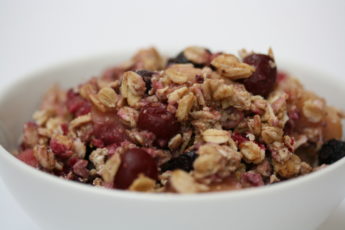
Apple-Berry Crisp
Filling:
6-8 McIntosh or Golden Delicious Apples
8 ounces fresh or frozen blueberries
1 tablespoon lemon juice
Pinch of sea salt
¼ teaspoon cinnamon
Pinch of cardamom
½ cup apple juice mixed with 1 tablespoon arrowroot powder (this acts like corn starch)
Crisp:
2 cups rolled oats
½ cup whole grain spelt flour
¼ cup cold pressed coconut oil
2 tablespoon maple syrup
Pinch of sea salt
Pinch of cinnamon
- Rinse apples (peeling is optional if they are organic). Quarter them, remove seeds and slice thinly.
- Place apples and blueberries in baking dish. Sprinkle with lemon juice, sea salt, cinnamon and cardamom and pour juice over fruit. Toss to mix.
- Mix crisp ingredients and crumble over fruit evenly.
- Press down gently; bake at 350 degrees F, for 30 to 45 minutes, until crust is crunchy and golden and apples are soft.